
How signage affects purchase decisions goes beyond attracting attention. Signs help people notice a business, find its entrance, judge its professionalism, and remember it later. A 2026 national survey reports that consumers consider signage when deciding where to buy, but these self-reported opinions do not establish sales gains for an individual Sarasota business.
A report published November 9 gives local owners a reason to inspect the customer approach, not automatically order a bigger sign.
Key takeaways:
- Consumer opinions are not measured sales gains.
- Readability helps customers find a business.
- Visual clarity can support perceived professionalism.
- Audit the storefront before choosing an upgrade.
Start by checking what customers can see before they reach the entrance.
What does the 2026 survey reveal about how signage affects purchase decisions?
A national survey found that 84% of respondents say signage impacts their decision to purchase from a business. This measures reported opinion, not completed purchases or sales growth. The findings represent U.S. adults, not a separate sample of Sarasota shoppers, so local businesses should use them as prompts for inspection.
The survey of 2,007 U.S. adults was conducted online by The Harris Poll on behalf of sign franchisor Signarama from July 9 to 12, 2026. The November 9 report appeared in Sign Builder Illustrated. Read the 2026 national consumer signage survey for the reported findings and methodology.
The report also says 39% have entered a business solely because of its sign. That is a separate past-behavior measure, not the next stage of an 84% sales funnel. Neither figure predicts what a particular sign will achieve.
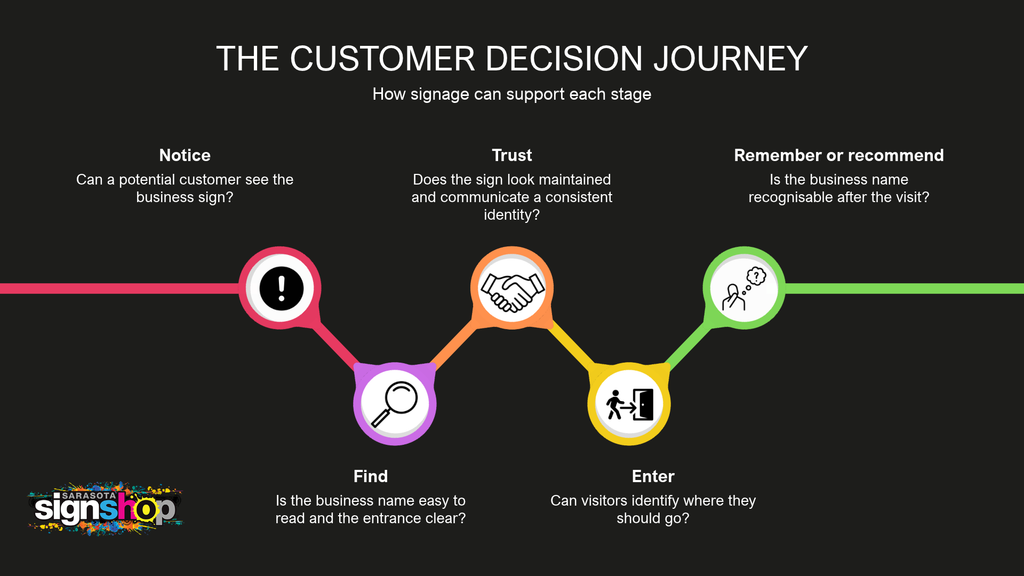
Why can signage shape trust before a customer enters?
A business sign provides early cues about its identity, care, and professionalism. In the national survey, 90% say signage impacts whether they view a business as professional or high-quality, while 82% say it impacts their trust. These responses describe perception, not proof of service quality or business reliability.
A readable name and consistent identity can reduce uncertainty before someone speaks to an employee. However, an attractive sign cannot guarantee a positive experience or make an unreliable business trustworthy.
Hypothetical Sarasota example: A roadside sign displays one business name, but the entrance carries a different name. A first-time visitor may hesitate because the correct door is unclear. Consistent naming across signs can help resolve that uncertainty.
What sign problems can keep customers from finding or entering a business?
Difficulty finding a business and deciding not to enter are different problems. In the national survey, 41% say they have been unable to locate a business because its sign was difficult to read. Separately, 17% say they have chosen not to enter a business because of its sign.
The second response does not establish that readability was the reason. Both figures describe respondents’ reported experiences, not the likelihood that a Sarasota customer will behave the same way.
Check the name from a safe viewing position and the normal pedestrian approach. Look for obstructed sightlines, competing messages, and an entrance that is difficult to identify. Ask someone unfamiliar with the property whether they can recognise the business and locate its door.
For more detailed readability guidance, see making your sign readable from the road.
What does the survey suggest about storefront signs versus other formats?
A main storefront sign remains an important attention cue in the survey: 63% say it is among the signage types most likely to catch their attention when noticing a business for the first time. This is a reported preference, not proof that one format works best for every property or customer.
The main sign should make the business identifiable. Window graphics and interior signs can support other tasks, such as communicating opening information or helping visitors navigate.
Before adding another message, check whether the main sign is clear and easy to associate with the entrance. Explore storefront signs when considering options for a commercial property.
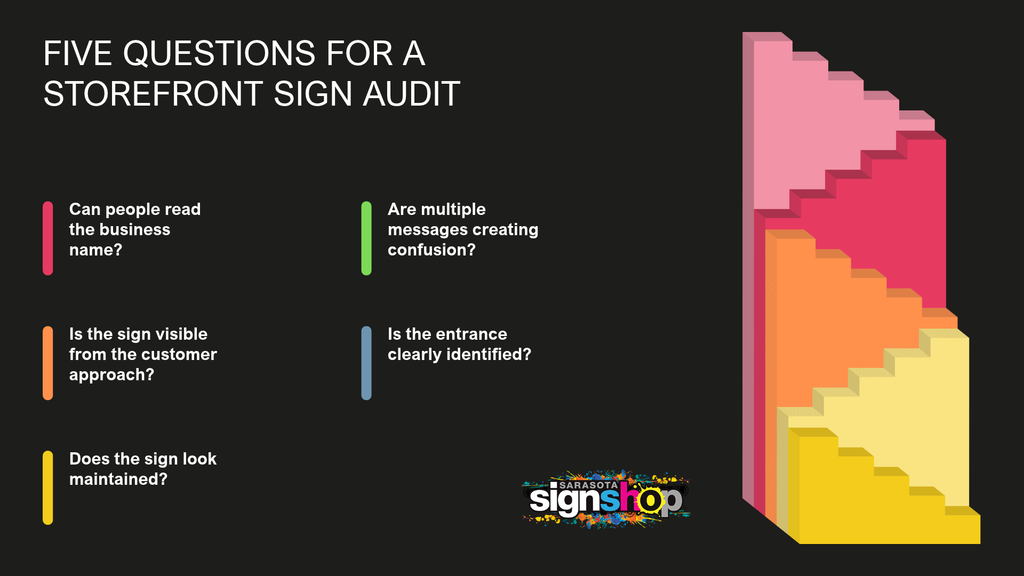
How can Sarasota owners audit their signs using the survey findings?
A sign audit is a structured review of visibility, message clarity, condition, and entrance identification. The figures below are national survey opinions, not local performance measures. Use the middle column as practical interpretation, then inspect the actual customer approach before deciding what needs attention.
| Survey finding | What it means for your sign | What to check on your storefront |
| 91% say an easy-to-read font is important | Readability supports identification | Can people recognise the business name? |
| 89% say street visibility is important | Sightlines affect whether a sign can be seen | Are trees, buildings, or other signs obstructing it? |
| 90% say signage impacts professional or high-quality perceptions | Condition and consistency shape impressions | Is the sign maintained and the identity consistent? |
| 79% agree too many signs can create confusion | More messages may compete for attention | Are several signs repeating or conflicting? |
| 93% say signage impacts business recall | Recognition matters beyond the first visit | Is the business name and branding recognisable? |
These checks translate survey responses into questions. They do not show that a particular change will cause a specific result.
Return to the hypothetical entrance-name mismatch: check both names from the customer’s approach. Also inspect local conditions such as glare, vegetation, sun exposure, and sign condition. These are site considerations, not findings from the survey. For more on sign placement and visibility, see the related guide.
What else should owners know before using signage statistics?
Signage statistics can help owners decide what to inspect, but they cannot forecast revenue. The source population, question wording, and type of response matter. Opinions about importance, reported past experiences, and preferences measure different things, so they should not be combined into a conversion rate.
Does an 84% survey result mean my sales will rise by 84%?
No. The figure measures how many respondents say signage impacts their purchase decisions. It does not measure sales lift, predict purchase probability, or estimate revenue for an individual business.
Should a small business replace every sign at once?
No. The survey does not support a blanket replacement recommendation. Identify the specific problem, then consider site conditions, approved scope, and budget before deciding what to retain, revise, or replace.
How can I tell whether a sign change helped my business?
Compare similar periods and track customer discovery responses, visits, or inquiries where available. Seasonality, promotions, and other changes can also affect results. For more on measuring signage performance, consider how attribution, meaning identifying which activity contributed to a result, affects interpretation.
How should Sarasota businesses act on these findings?
Use the survey to prioritise a customer-view inspection, identify a specific obstacle, and consider a proportionate solution. Understanding how signage affects purchase decisions means looking beyond attention to whether people can find, recognise, trust, and remember a business. The national responses offer context, not a promise of local sales growth.
Before replacing a sign, review the actual site and the customer goal. Sarasota Sign Shop can discuss a commercial signage project based on the information available. Share storefront photos, the customer approach, existing artwork, and the problem you want to solve to begin that conversation.