
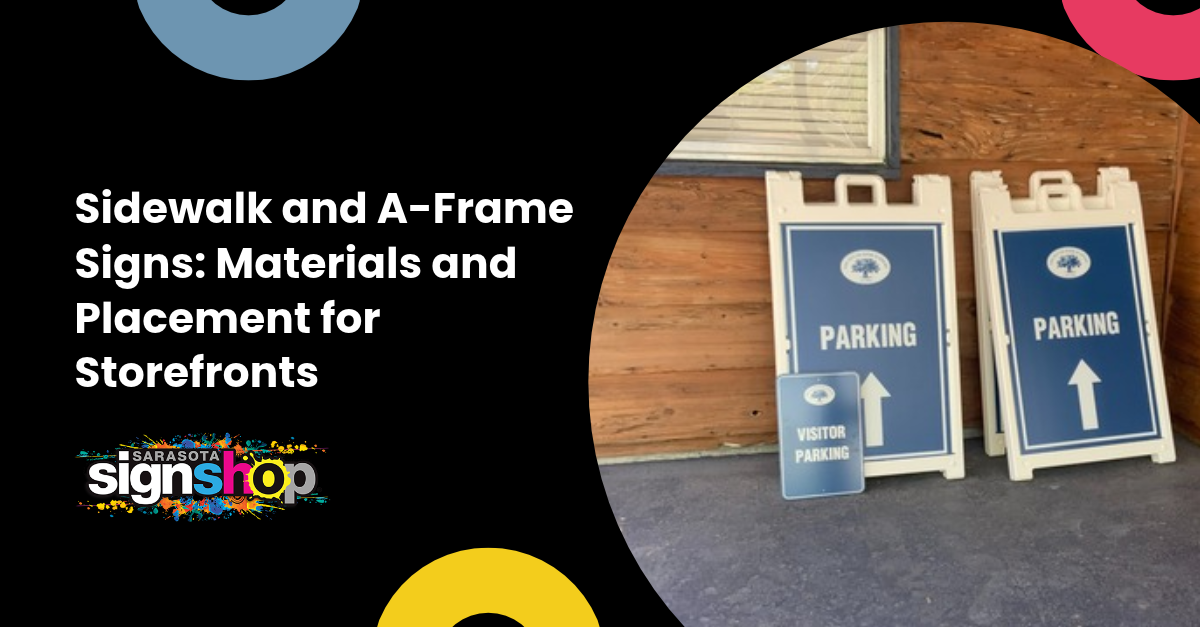
Quick answer: A-frame signs work best when the frame, printed panels, and placement suit daily storefront conditions. Compare compatible materials, replacement options, and manufacturer instructions, then confirm local rules and pedestrian access before ordering. Florida rain and wind require appropriate handling, not an assumption that every outdoor sign can stay outside indefinitely.
A-frame signs are portable signs with two faces supported in an A-shaped stance. They help a storefront communicate clearly with nearby pedestrians, but choosing one involves more than design. The frame, printed graphic face, open footprint, and daily handling all matter. Sidewalk signs describe a sign’s use or location and can include other portable designs.
A hypothetical Sarasota cafe has a narrow entrance and changes its menu daily. Its sign needs an updateable message and an unobstructed location.
Key takeaways
- Choose the frame and graphic face separately.
- Confirm permissions and pedestrian access before choosing a location.
- Plan for changing messages, weather, and storage.

How do you choose a-frame signs for daily storefront use?
For anyone asking how to choose a-frame signs for a storefront, selection should start with message changes, available placement, storage, and handling. Appearance matters, but so do compatible panels and the open footprint. Consider who sets it up, how often the message changes, and where it can be stored when closed.
The frame supports the sign; the graphic face carries its message. Some systems use fixed graphics; others accept replacement sign panels for portable storefront signs. Confirm whether one or two faces suit the approach.
Ask who handles it and where it will be stored. Confirm dimensions and insert specifications before approving final artwork. Explore storefront signs for commercial planning.
Which frame and panel materials fit outdoor storefront use?
Frame durability and graphic durability are separate decisions. Suitability depends on product construction, finish, and manufacturer instructions for the intended outdoor conditions, not its name. A rigid face cannot stabilise unsuitable frames. Also consider support, exposure, and storage between uses.
Corrugated plastic sign inserts are fluted polypropylene panels. Plastic and metal frames, plus sandwich board signs, need compatible panels and finishes. Lamination does not waterproof every edge or joint.
These are options, not inventory. See durable signs for Florida weather for model guidance.
Where can a sidewalk sign go without obstructing access?
A sidewalk sign should go only where local rules, property permissions, and pedestrian clearance requirements allow it. Sidewalk sign placement is not automatically approved by appearance. Check the footprint of the open sign, not its panel, and keep the entrance route usable.
Check door swing, route, and curb ramps. ADA Standards address accessible routes, not permission for advertising. See the 2010 ADA Standards. Identify private property versus public right-of-way, land reserved for public travel or related uses. Florida Statutes section 337.406 restricts certain uses of state transportation facility right-of-way; confirm whether it covers the address. See Florida Statutes section 337.406.
For the cafe, a spot narrowing its entrance is unsuitable. The owner should seek an approved alternative, not choose a smaller panel. Confirm the address and footprint with the authority and property owner before setup. Read about business sign placement.
What should the message say to passing pedestrians?
A pedestrian-facing message should communicate one main idea, use clear contrast, and offer a simple next step. Someone walking past may have only a moment to understand it, so a short offer, service, or direction is easier to process than competing promotions.
Consider whether both faces need the same wording. Each side should make sense from its intended approach. Review the proof in its final orientation and actual lighting.
The hypothetical cafe could feature one daily special rather than a full menu. Keep essential information readable; do not rely on a QR code as the only way to access it.
How should you handle rain, wind, cleaning, and storage?
Outdoor a-frame signs should not remain outside in every condition. Safe handling depends on the exact frame instructions and site exposure. Follow the manufacturer’s setup, ballast, cleaning, and storage guidance. Ballast means stabilizing weight accepted only by products designed for it.
Check hinges, handles, panel retention, and the frame for damage. Check before every opening. Bring it inside when instructions or weather require it.
Do not assume a heavier panel solves wind concerns, add improvised weights, or treat lamination as waterproofing. A manufacturer’s fill instructions apply only to its own frame. Ask about replacement graphics before replacing the whole system.
What else should you confirm before ordering a sidewalk sign?
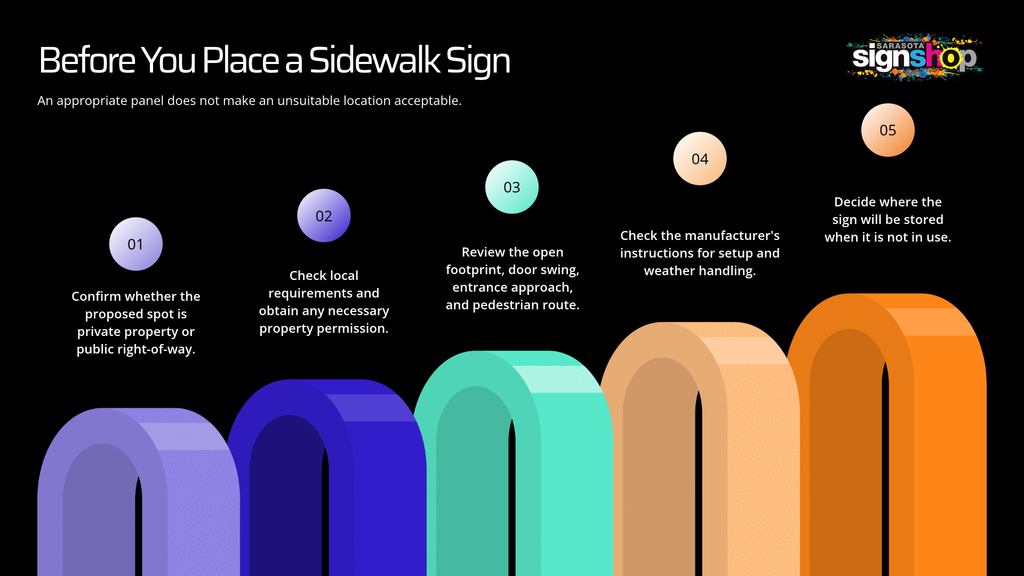
Before ordering, confirm whether the chosen frame accepts replacement graphics, its panel specifications, and how the sign should be handled. Also check whether a digital action is useful and whether the proposed placement needs approval. Product compatibility and local requirements are separate questions. The frame model and intended site determine what needs checking.
Can I replace only the printed panels?
Sometimes, if the frame is designed for inserts. Confirm panel dimensions, thickness, retention method, and compatibility with the exact model before ordering and printing a replacement face.
Should I put a QR code on my sign?
Only when it supports an action and can be tested from the intended approach and lighting conditions in use. Do not make it the only way to access essential information.
Does a portable sign automatically avoid permit review?
No. Classification and approval depend on the address, jurisdiction, proposed placement, and current rules. Check with the relevant authority. Portable status alone does not decide the classification for that address.
Conclusion
A-frame signs work when the frame, graphic face, location, and daily routine fit together. A suitable panel is only one part of the decision. The open footprint, pedestrian access, weather handling, and local permissions need attention.
If you are considering a-frame signs for a Sarasota storefront, Sarasota Sign Shop can discuss your commercial signage requirements. Share a site photo, proposed location, desired message, update frequency, and opening or campaign date. This starts a practical conversation about format and production needs, without assuming a particular frame is suitable or available.