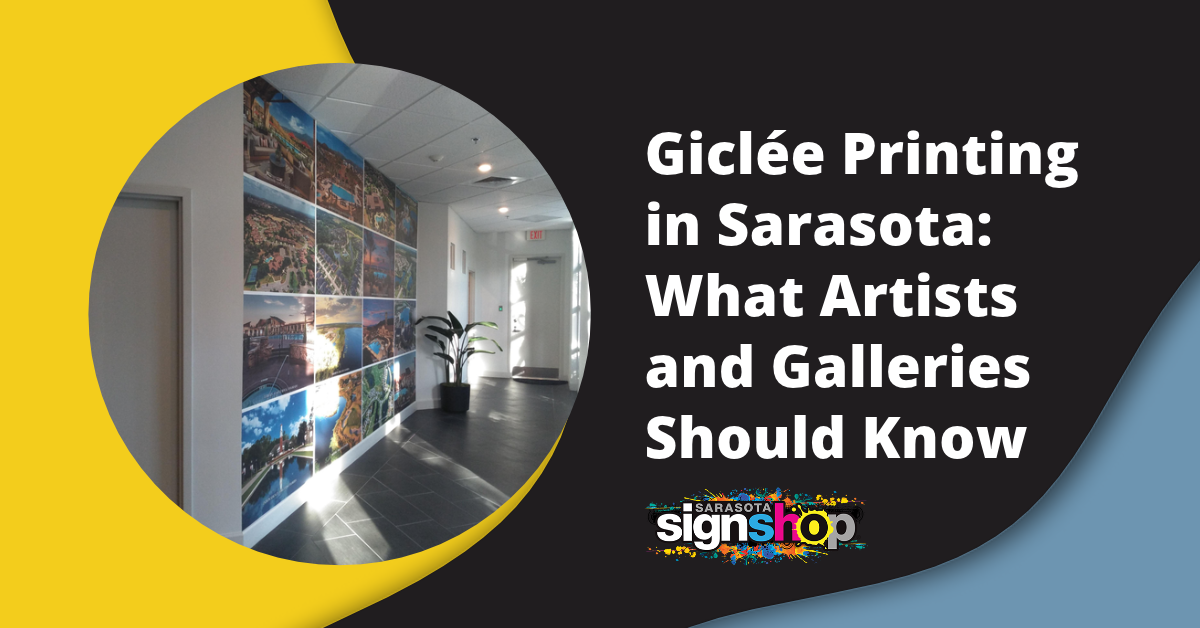
Giclée printing generally refers to fine art inkjet reproduction, often using pigment inks and specialty paper or canvas. For Sarasota artists and galleries, the useful questions concern the actual ink and media combination, artwork preparation, proof approval, and display conditions. The label alone does not establish color accuracy or permanence.
When comparing giclee printing sarasota providers, look beyond the name of the process. Ask what materials are available and how the finished print will be assessed.
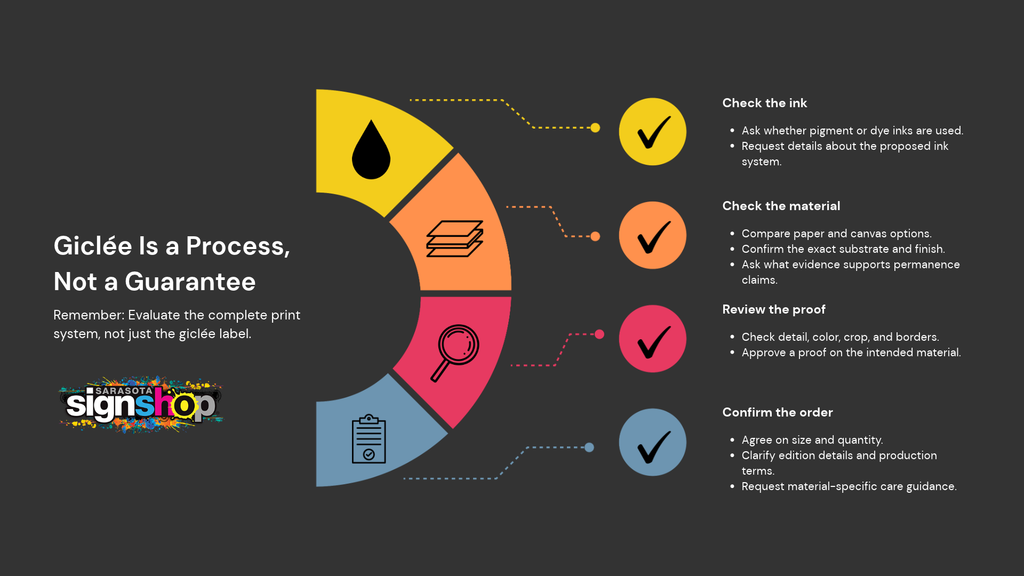
- Confirm inks and media, not just the giclée label.
- Approve a proof on the intended material.
- Evaluate image detail at the intended print size.
- Request care guidance and clear production terms.
What does giclée printing mean for fine art reproductions?
Giclée describes a fine art inkjet printing approach, not a universal quality certification. The process can use pigment inks, which contain small particles of color rather than relying on dissolved dyes. However, the ink, paper or canvas, preparation, and handling all affect the result. A reproduction is a printed interpretation of an original, not the original artwork itself.
Artists considering fine art printing services should confirm the specific process offered for their project. The service page describes fine art reproduction options, but buyers should ask which ink and media combinations are currently available. Not every inkjet print is archival, and the term giclée does not guarantee museum acceptance or a particular lifespan.
How do you compare giclee printing Sarasota shops offer?
Compare providers by asking for details that can be checked, rather than relying on broad descriptions. Ask what materials and inks will be used, what evidence supports permanence claims, and whether you can approve a proof on the intended surface before ordering an edition.
| Claim or feature | What to verify |
| Giclée label | Actual ink and media combination |
| Archival claim | Applicable test and conditions |
| Color accuracy | Proof on intended material |
| Edition consistency | Retained approved reference |
These are purchasing questions, not automatic pass or fail tests. For example, an archival claim should relate to the complete print system and stated conditions, not simply the paper or ink in isolation. Ask for relevant documentation and clarify what it covers. A provider should be able to explain the proposed workflow without relying on a label alone.
How do paper, canvas, and inks affect the result?
The surface, texture, finish, ink compatibility, and viewing conditions all influence a print’s appearance. The substrate is the material receiving the image. Permanence means resistance to change under specified conditions, not a guarantee that a print will remain unchanged in every environment.
Paper can preserve fine detail and suit work intended for a traditional print presentation. Canvas has a different texture and surface character that may affect perceived detail and contrast. Neither is automatically the better choice. A textured original may suit canvas aesthetically, but a sample on the intended material is more useful than assuming canvas is always superior.
Ask which ink and substrate combination is proposed and whether relevant test documentation is available. Acid-free paper alone does not establish the permanence of the complete print system. The paper, ink, display conditions, and handling all matter.
How should artists prepare files and approve a proof?
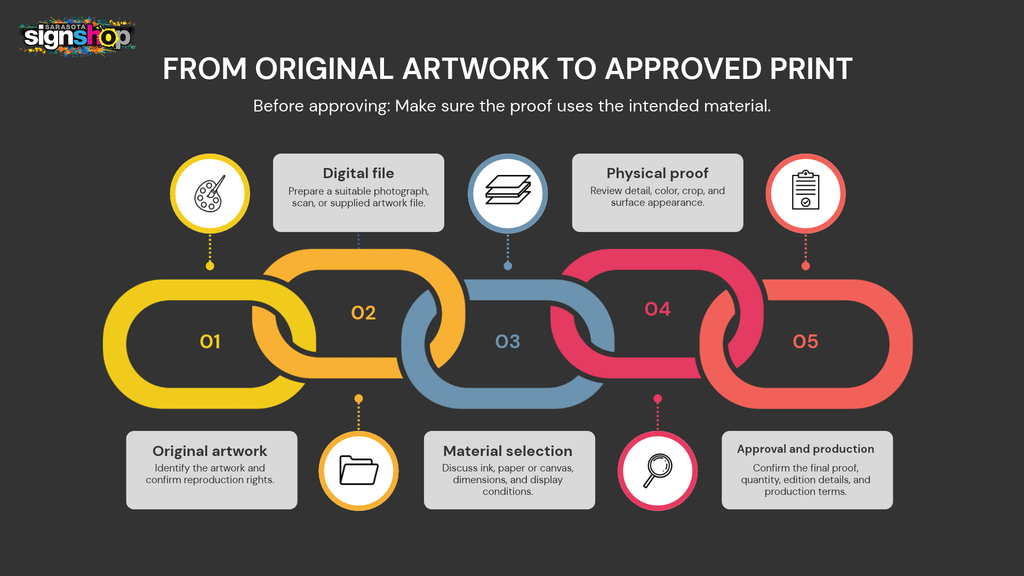
Prepare the file around the final print dimensions, crop, borders, image detail, and the provider’s requested format. A proof is a sample used to review the expected appearance before a production run. It provides a more useful approval reference than relying on a screen image alone.
Ask whether the original needs professional photography or scanning, and confirm who will supply that file. If an ICC profile is discussed, it describes color behavior for a device or printing condition. Profiles help coordinate color between devices, but do not promise identical screen and print appearance. The International Color Consortium explains how profiles support color management between devices. ICC guidance.
Hypothetical example: An artist wants to reproduce a watercolor with pale washes. A small proof on the selected paper can help reveal whether subtle areas remain visible and whether the overall appearance is acceptable before approving the full quantity.
Ask how file review and proof approval are handled. The shop’s overview of its printing and finishing process provides general production context, but does not establish a particular archival giclée workflow.
What should a gallery confirm before ordering an edition?
Before ordering, confirm the print dimensions, quantity, borders, approved proof, repeat-order reference, finishing, packaging, budget, and requested date. Ask what the quote includes and which options require separate approval. Scheduling should be confirmed for the specific project rather than assumed from a general turnaround statement.
An edition also involves decisions that belong to the artist. Numbering, edition size, signatures, and authenticity documentation are separate from the printing method. A print does not become a limited edition simply because it is described as giclée.
For an actionable inquiry, review the information to include in a print quote request. Then ask what is included in production and what needs to be arranged separately.
How should fine art prints be displayed and handled?
Handle prints with clean hands and a clean work area, protect them from direct sunlight and moisture, and follow care guidance for the specific material. Framing and storage choices should suit the print and its intended display environment.
Sarasota’s humidity and indoor conditions make storage and display worth discussing before ordering. The Library of Congress recommends stable, relatively dry storage conditions and minimal light exposure for works on paper. Its guidance also advises protective enclosures and careful handling. These recommendations concern paper materials and should not be treated as universal instructions for every canvas or coating. Library of Congress paper care guidance.
Florida weather resistance for outdoor signs does not establish fine art print permanence.
What else should artists and galleries know before ordering prints?
The remaining practical questions usually concern reproduction rights, proof availability, and edition planning. Clarifying these points before production helps artists and galleries understand what they are authorizing, what they will approve, and how the finished prints will be described.
Do I need permission to reproduce someone else’s artwork?
Reproduction generally requires ownership of applicable rights, permission, or another lawful basis. Owning a physical original does not necessarily transfer copyright. Check the rights before authorizing copies. The U.S. Copyright Office explains this distinction in its Copyright Basics circular.
Can I order a sample before committing to a full run?
Ask whether a sample or proof is available, what it costs, and whether it uses the final paper, canvas, and ink combination. Confirm whether the sample represents the intended production process before relying on it for approval.
Does a giclée print have to be a limited edition?
No. The printing method and edition size are separate decisions. An artist can choose an open or limited edition. The giclée label does not establish scarcity, investment value, authenticity, or a particular number of copies.
For artists researching giclee printing sarasota options, the most useful comparison is based on documented materials, proofing, and clear production terms. A provider should explain what can be confirmed for the proposed combination rather than treating the process name as proof of performance.
If you are planning fine art reproduction in Sarasota, bring or send your artwork file, intended dimensions, quantity, display conditions, and target date. Sarasota Sign Shop can discuss the project and confirm which materials and production options may be suitable. Ask specifically about ink type, available media, proofing, and any documentation relevant to your requirements before placing an order.