A signage checklist for property managers should cover more than the main entrance sign. Managed properties often develop signage problems as tenants move, buildings expand, parking patterns change, and repairs are made. Over time, outdated tenant names, inconsistent directories, temporary notices, damaged signs, and missing directions can make a property harder to navigate and less organized. A complete review should follow the property from the road through parking areas, buildings, interiors, amenities, and leasing spaces. This approach helps identify problems before they affect visitors, tenants, leasing activity, or the property’s appearance. Sarasota Sign Shop supports property managers with local design, production, replacement, and installation for coordinated Sarasota property signage.
Start at the Road: Can Drivers Identify the Property in Time?
The first checkpoint is the main entrance. Property managers should review whether drivers can identify the property early enough to make the correct turn.
Check:
- Monument signs
- Pylon or freestanding signs
- Development name signs
- Address numbers
- Tenant identification
- Entrance and exit markers
- Visibility from both traffic directions
- Landscaping obstruction
- Nighttime visibility
- Faded or damaged panels
A sign can be present but still ineffective if the lettering is too small, contrast is poor, or landscaping blocks the view. Consider traffic speed, viewing distance, competing visual clutter, letter height, and placement.
For a larger commercial property, the entrance sign should connect logically with the rest of the property’s commercial property signage. Drivers should know they have reached the correct location before they enter the site.
Check Tenant Panels and Property Directories
Tenant information is one of the most frequently updated parts of property management signs. Review every tenant directory sign and individual panel for accuracy and consistency.
Check for:
- Correct business names
- Current logos
- Correct suite numbers
- Consistent panel sizes
- Matching background colors
- Uniform typography
- Correct directional arrows
- Clean mounting hardware
- Appropriate viewing distance
- Removal of vacant or outdated panels
Common problems include new tenant panels that do not match older ones, temporary inserts that remain too long, inconsistent logo sizes, poor contrast, and old tenant names remaining after a move.
A standard tenant sign specification makes future updates easier. This is particularly important for multi tenant signage, where many individual businesses need to appear as part of one property system.
Follow the Vehicle Route Through the Property
Next, drive through the property as if you are visiting for the first time. Check whether property wayfinding signs appear before every important decision point.
Depending on the property, review:
- Entrance and exit signs
- Building direction signs
- Delivery instructions
- Loading zone signs
- Drive through directions
- Leasing office directions
- Visitor parking signs
- Tenant parking signs
- Garage entrance signs
- Clearance signs
- One way signs
- Pickup and drop off signs
Directional signs for properties should use short messages, readable lettering, clear arrows, and consistent placement.
A sign placed after a driver has already passed a turn does not solve the navigation problem. Construction, tenant changes, landscaping, and traffic pattern changes can also make an older wayfinding system ineffective.
Review Parking Signs as a Complete System
Parking areas should be reviewed according to different user needs.
Visitor and customer parking
Identify where short term visitors should park and make the information easy to see from the vehicle approach.
Reserved and tenant parking
Use consistent wording, numbering, and placement for reserved spaces and tenant areas.
Accessible parking
Confirm that relevant signs are present, visible, and reviewed against current property requirements.
Service and loading areas
Identify delivery zones, loading areas, waste access, and restricted areas where appropriate.
Towing and enforcement notices
Review wording, placement, and condition against the property’s policies and applicable requirements.
The goal is not simply to have enough parking signs. The signs should form an understandable system that helps people know where they can and cannot park.
Confirm That Every Building and Suite Is Easy to Find
Review building identification signs from parking areas, internal roads, and pedestrian routes.
Check:
- Building letters or numbers
- Street facing addresses
- Suite numbers
- Door identification
- Floor numbers
- Stair and elevator identification
- Department signs
- Reception signs
- Tenant entrance signs
A directory might direct someone to Building C, but the navigation system fails if Building C is difficult to identify when the visitor reaches the parking area.
Check visibility during both daytime and nighttime where applicable. Property managers should also review whether signs remain visible after landscaping changes, renovations, or new construction.
Walk the Pedestrian Route Separately
Vehicle signage does not automatically work for pedestrians. Walk common routes from parking spaces to building entrances and final destinations.
Review:
- Walkway directions
- Building entrance signs
- Elevator and stair signs
- Reception directions
- Restroom signs
- Amenity directions
- Courtyard identification
- Directory maps
- Temporary detour signs
- After hours entrance instructions
Pedestrian signs generally need eye level placement, short messages, clear arrows, readable maps, and consistent terminology.
Property managers should identify every point where a first time visitor might hesitate. This can reveal missing property wayfinding signs that are not obvious when reviewing individual signs in isolation.
Inspect Interior Identification and Wayfinding
Continue the audit inside each building. Review signs in:
- Lobbies
- Reception areas
- Shared hallways
- Elevator banks
- Stairwells
- Conference areas
- Restrooms
- Tenant floors
- Service corridors
- Management offices
Separate brand signs from room identification, directional signs, informational notices, and signs that may be required for the property.
A sheet of paper taped to a wall may solve an immediate problem, but it should not automatically become the permanent solution. Depending on the application, dimensional letters, wall graphics, door graphics, directories, and changeable sign systems may provide a more appropriate long term result.
Review Amenity and Shared Space Signs
Apartment complex signs and other managed property signage should also cover shared spaces. This applies to multifamily properties, offices, hospitality facilities, mixed use developments, and managed communities.
Review signs for:
- Pools
- Fitness centers
- Clubhouses
- Mailrooms
- Package rooms
- Business centers
- Conference rooms
- Dog parks
- Playgrounds
- Bike storage
- Trash and recycling areas
- Shared outdoor spaces
Amenity signs may need to communicate identification, hours, rules, directions, safety information, or reservation instructions.
The design should remain consistent with the property rather than appearing as a collection of unrelated additions.
Audit Leasing and Vacancy Signage
Leasing areas require their own review. Check leasing signs, window graphics, building banners, temporary yard signs, directional signs, suite specific signs, construction graphics, future tenant panels, contact information, and QR codes where appropriate.
Leasing information should be easy to update as spaces become available or are filled. Outdated availability messages should be removed promptly.
A coordinated system can also make leasing areas easier to find. For example, a property might use a building banner to attract attention from the road, followed by directional signs for properties that guide prospects toward the leasing office.
Managing tenant changes or leasing updates across a Sarasota property? Sarasota Sign Shop can produce coordinated tenant panels, window graphics, directional signs, and temporary leasing displays from one approved design system.
Replace Temporary Notices That Have Become Permanent
Temporary notices are useful during repairs, transitions, and events. Problems arise when they remain in place indefinitely.
Look for:
- Paper notices taped to doors
- Handwritten parking signs
- Faded temporary arrows
- Old construction banners
- Damaged yard signs
- Printed notices in plastic sleeves
- Mismatched temporary tenant panels
Frequently repeated information may be better served by durable property management signage.
Check Brand Consistency Across the Entire Property
Review whether signs share consistent:
- Colors
- Fonts
- Logo placement
- Arrow styles
- Materials
- Finishes
- Terminology
- Panel proportions
- Mounting heights
Inconsistencies can result from different vendors, tenant turnover, renovations, emergency replacements, or a lack of approved sign standards.
Sarasota Sign Shop provides in house design and production, helping property managers coordinate colors, materials, layouts, and replacement panels across a larger property. Local production can also simplify communication when multiple signs need to be updated together.
Inspect Every Sign for Florida Weather Damage
Regular property sign maintenance should include a condition check for:
- Fading
- Peeling graphics
- Corrosion
- Cracked panels
- Loose hardware
- Warping
- Water intrusion
- Mildew or staining
- Broken illumination
- Leaning posts
- Damaged sign faces
- Landscaping growth
- Storm related impact
Sarasota properties can experience strong sunlight, heat, humidity, rain, wind, and salt air in some locations. Outdoor signs should therefore be reviewed periodically and after significant weather events.
If a sign structure appears loose or damaged, it should be evaluated professionally rather than treated as a simple cosmetic repair.
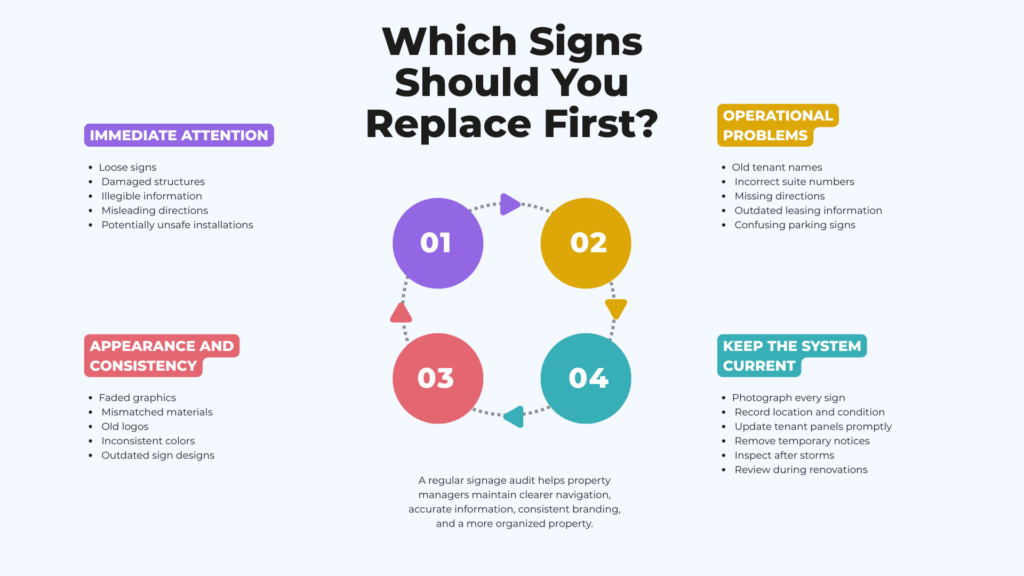
Prioritize Repairs and Replacements
A simple priority system can help property managers create a practical commercial sign replacement plan.
Priority 1: Immediate attention
Loose, damaged, misleading, illegible, or potentially unsafe signs.
Priority 2: Operational problems
Outdated tenant names, missing directions, incorrect suite information, or signs causing visitor confusion.
Priority 3: Appearance and consistency
Faded branding, mismatched finishes, outdated graphics, and signs that no longer match the property.
This approach allows managers to address the most important problems first rather than replacing every sign at once.
Build a Repeatable Signage Management Process
A recurring signage audit can become part of normal property management.
- Create a property sign inventory.
- Photograph each sign.
- Record its dimensions, location, and condition.
- Maintain current brand files.
- Keep an approved tenant panel specification.
- Review signs during tenant turnover.
- Schedule routine condition checks.
- Reinspect after storms and renovations.
- Remove outdated temporary signs.
- Use one point of contact for coordinated updates.
This process can help manage Sarasota property signage across commercial centers, office parks, multifamily properties, and mixed use developments.
Sarasota Sign Shop can support this process with in house design, production, commercial grade materials, and site specific installation planning throughout Sarasota, Lakewood Ranch, Bradenton, and Venice.
Conclusion
A signage checklist for property managers should evaluate the entire property as one connected system. Start with roadside identification, then review tenant panels, vehicle and pedestrian wayfinding, parking, building identification, interiors, amenities, leasing areas, temporary notices, and physical condition.
Regular reviews can identify outdated information, damaged signs, missing directions, and inconsistent branding before they become larger operational problems. With coordinated commercial property signage, property managers can make sites easier to navigate, maintain a stronger presentation, and respond more efficiently to tenant and property changes.
Schedule a Property Signage Review With Sarasota Sign Shop
Sarasota Sign Shop designs, produces, and installs commercial signage for managed properties throughout Sarasota, Lakewood Ranch, Bradenton, and Venice. Request a quote or schedule a consultation to review tenant panels, directories, parking signs, wayfinding, leasing graphics, building identification, and replacement needs across your property.